When Did Usa Start Exporting Oil Again
From Ballotpedia
Jump to: navigation, search
This article does not receive scheduled updates. If you lot would like to aid our coverage grow, consider donating to Ballotpedia. Contact our team to propose an update.
 on Energy on Energy |
| |
|---|
| |
| |
| |
| |
| |
 |

The crude oil export ban prohibited most crude oil exports from the Usa to other countries. Information technology was implemented in 1975 and lifted in December 2015.[1] [2]
Due to an increased apply of hydraulic fracturing—also known as fracking—and horizontal drilling beginning in 2005, the Us increased its production of oil and natural gas. Opponents of the ban argued repealing it would increase job growth and domestic energy production. Proponents of the ban argued that its repeal could lead to higher domestic gasoline prices and negatively affect jobs at U.S. refineries.[4] [v]
Groundwork
-
- Come across likewise: Historical energy policy in the United states
In 1973, Arab members of the Organization of the Petroleum Exporting Countries (OPEC), an intergovernmental organization, imposed a ban on petroleum exports to the United States and to other countries that supported the state of State of israel during the 1973 Arab-Israeli conflict. OPEC likewise cutting oil production, leading to rise gasoline prices in the Usa. At the time of the embargo, U.Due south. policies encouraged oil imports over domestic oil product. In response to the embargo and college domestic gasoline prices, Congress passed the 1975 Energy Policy and Conservation Act, which directed the president to ban crude oil exports except for select types of oil.[6] [7] [8]
On September x, 2015, the Business firm Energy and Power Subcommittee approved a bill to allow crude oil exports. The U.South. Firm of Representatives voted on Oct 9, 2015, to elevator the crude oil export ban. The 261-159 vote passed, though the mensurate stalled in the Senate. President Barack Obama (D) promised to veto the bill. The Consolidated Appropriations Human activity of 2016 (HR 2029) included a provision to cease the consign ban. It passed both houses of Congress and was signed by President Obama on Dec 18, 2015. The full text of the spending bill can be accessed hither.[9] [10] [11] [12] [13] [14]
Debate
Opponents
Prior to the ban's repeal in 2015, opponents of the ban had made the post-obit arguments favoring its repeal:[15] [sixteen]
- Lifting the ban would create jobs and economic growth.
- Less domestic crude oil production restricts the ability of state and local governments to collect taxation revenue from energy product.
- The ban keeps rough oil prices beneath market prices, resulting in less production.
As of 2015, involvement groups that had opposed the ban included the Brookings Institution, the Council on Strange Relations, and the American Petroleum Institute.[17]
In July 2013, Blake Clayton, adjunct young man for energy at the Council on Foreign Relations, argued that "removing all proscriptions on crude oil exports, except in extraordinary circumstances, will strengthen the U.S. economy and promote the efficient development of the country'due south energy sector." Clayton argued that the ban served certain oil refineries in the U.s.a. rather than American consumers and that repealing the ban would increase product, contending, "Letting drillers reap extra profits from selling crude oil overseas, if the market dictates, would provide greater incentives for drilling, stimulating new supply."[fifteen] [eighteen]
In Jan 2014, Tim Boersma and Charles K. Ebinger of the Brookings Institution argued, "Domestic consumers do not substantially do good from an export ban, and U.S. oil producers may soon be affected negatively by it." The authors contended that lifting the ban could generate up to $fifteen billion per year and effect in increased domestic oil production and thus greater income for employees, more jobs, and more tax acquirement for federal, state, and local governments. Alternatively, the authors argued that the potential disadvantages of lifting the ban could include rising domestic oil prices and fewer jobs at U.S. refineries that process domestic crude oil.[16] [half-dozen] [19]
In a report issued in September 2016, the American Petroleum Establish argued that the ban prevents U.S. oil producers from accessing global markets, which leads to lower prices and thus less incentives for producers to increase production. The report contended, "The alternative [to lifting the ban] is a kind of energy isolationism, the shutting-in of domestic product from global markets, depressing prices for that output and eventually discouraging new production. This works against U.Due south. competitiveness and American consumers."[twenty]
Proponents
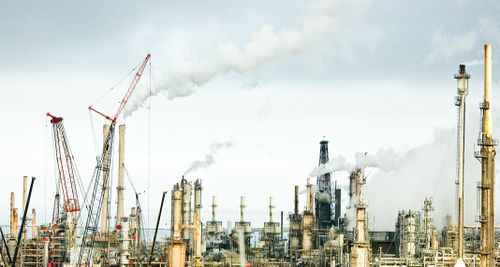
An oil refinery near Rodeo, California.
Proponents of the ban made the following arguments:[21]
- Repealing the ban would atomic number 82 to fewer jobs at U.S. refineries considering crude oil would exist exported to strange refineries.
- Lifting the ban could increase carbon dioxide (CO2) emissions.
- Lifting the ban could lead to higher domestic oil and gasoline prices.
Every bit of 2015, interest groups that supported the ban included the United Steelworkers Matrimony, the Sierra Club, and the Center for American Progress.
In June 2015, Leo W. Gerard, international president of the United Steelworkers, argued that lifting the ban would negatively affect jobs at U.Due south. refineries. Gerard argued, "Lifting the ban would non just show detrimental to the jobs of the men and women employed at U.S. refineries, but also to the communities that rely on the tax base generated from these wages."[22]
In June 2015, Mike Brune, executive director of the Sierra Gild, contended that repealing the ban would increase CO2 emissions and thus outcome in human-acquired climate change and global warming, arguing, "Lifting the crude oil export ban will also increase greenhouse gas emissions, hampering our nation's efforts to combat climatic change and lower U.South. emissions."[22]
In January 2014, Daniel J. Weiss and Miranda Peterson of the Middle for American Progress argued that lifting the ban could increase gasoline prices in the same way that gasoline prices rose after Congress repealed a ban on Alaska's crude oil exports to the lower 48 states in 1996. Weiss and Peterson contended, "This experience suggests that lifting the crude oil export ban could similarly raise gasoline prices because 68 per centum of the price of a gallon of gasoline is the price of oil, according to [Energy Information Administration] EIA.[23]
Contempo news
The link below is to the most recent stories in a Google news search for the terms Crude oil export ban. These results are automatically generated from Google. Ballotpedia does not curate or endorse these manufactures.
See also


Footnotes
- ↑ The Hill, "Spending deal to lift oil export ban," Dec 15, 2015
- ↑ The Economist, "America lifts its ban on oil exports," Dec eighteen, 2015
- ↑ The Brookings Institution, "Changing Markets Economic Opportunities from Lift the U.S. Ban on Crude Oil Exports," September 2014
- ↑ Forbes, "End Of Crude Oil Export Ban Could Take Negative Unintended Consequences," December 22, 2015
- ↑ 6.0 6.1 The Washington Mail, "U.S. oil exports have been banned for 40 years. Is it time for that to change?" January viii, 2014
- ↑ Congressional Enquiry Service, "Energy Policy:Historical Overview, Conceptual Framework, and Continuing Issues," December 21, 2004
- ↑ U.S. Department of Land, "Milestones:1969-1976," October 31, 2013
- ↑ The Guardian, "Business firm votes to lift crude oil export ban despite opposition from White House," October nine, 2015
- ↑ Fox News, "House votes to lift 40-twelvemonth-old ban on United states crude oil exports," October ix, 2015
- ↑ U.Due south. News and Earth Report, "Bill to Opposite Ban on U.S. Oil Exports Advances in House," September 10, 2015
- ↑ The Washington Postal service, "The huge political horse merchandise in the budget that will alter where the U.S. gets its free energy," December 16, 2015
- ↑ The Hill, "Deal to terminate oil consign ban in sight," December ten, 2015
- ↑ Library of Congress, "H.R.2029 - Consolidated Appropriations Act, 2016," accessed December 22, 2015
- ↑ fifteen.0 15.i Council on Foreign Relations, "The Case for Allowing U.S. Rough Oil Exports," accessed March 25, 2015
- ↑ xvi.0 16.1 David Porter Railroad Commissioner, "It's Time to Cease the Crude Oil Export Ban," March 16, 2015
- ↑ Texas Tribune, "Abbott Signs Call to Elevator Rough Oil Export Ban," May 29, 2015
- ↑ American Petroleum Institute, "U.S. Crude Oil Exports," February 2015
- ↑ Brooking Institution, "Lift the Ban on U.Due south. Oil Exports," January 23, 2014
- ↑ American Petroleum Institute, "U.S. Crude Oil Exports: Benefits for America'south Economy and Consumers," September 2016
- ↑ Cite error: Invalid
<ref>tag; no text was provided for refs namedprice of oil - ↑ 22.0 22.i United Steelworkers Union, "USW Urges Senate to Keep Domestic Crude Oil Consign Ban In Place," June x, 2015
- ↑ Centre for American Progress, "Keep American Crude Oil at Home," January 28, 2014
| Ballotpedia | |
|---|---|
| Virtually | Overview • What people are maxim • Support Ballotpedia • Contact • Contribute • Chore opportunities |
| Executive: Leslie Graves, President • Gwen Beattie, Main Operating Officer • Ken Carbullido, Vice President of Ballot Product and Technology Strategy Communications: Alison Graves • Megan Dark-brown • Abigail Campbell • Sarah Groat • Lauren Nemerovski Contributors: Scott Rasmussen | |
| Editorial | Geoff Pallay, Editor-in-Chief • Daniel Anderson, Managing Editor • Ryan Byrne, Managing Editor • Cory Eucalitto, Managing Editor • Mandy Gillip, Managing Editor • Jerrick Adams • Victoria Antram • Dave Beaudoin • Jaclyn Beran • Marielle Bricker • Kate Carsella • Kelly Coyle • Megan Feeney • Nicole Fisher • Juan García de Paredes • Sara Horton • Tyler King • Doug Kronaizl • Amee LaTour • David Luchs • Brittony Maag • Roneka Matheny • Andrew McNair • Jackie Mitchell • Elisabeth Moore • Ellen Morrissey • Mackenzie Murphy • Samantha Post • Paul Rader • Ethan Rice • Myj Saintyl • Maddie Sinclair Johnson • Abbey Smith • Janie Valentine • Caitlin Vanden Smash • Joel Williams • Samuel Wonacott • Mercedes Yanora |
| Energy Policy | ||
|---|---|---|
| Background | Energy policy in the United States • Fracking in the U.s. • Energy utilisation in the United States • Electricity prices in the U.s. • Historic land electricity prices • Historic state natural gas prices • Land free energy production rankings • Environmental Policy • State ecology policy pages • Environmental policy in the United States • Free energy and Environmental News |  |
| Terms | Abandoned mine drainage • Biofuels • Biomass • BTEX • Clean Air Deed • Clean Water Human activity • Coal • Coalbed methane • Compressed natural gas • Crude oil • Directional drilling • Directional well • Electric filigree • Free energy siting • Ethanol • Flare • Flowback • Frac sand • Frack fluid • Fracking • Geosteering • Geothermal free energy • Horizontal drilling • Hydrocarbons • Hydroelectric free energy • Liquid Petroleum Gases • Megawatt • Megawatt hr • Methane • Mineral rights • Natural gas • Natural gas liquids • Natural gas storage • Naturally Occurring Radioactive Materials • Nuclear power • Oil shale • Petrochemicals • Petroleum • Petroleum systems • Produced water • Proppants • Public Trust Doctrine • Renewable free energy resources • Renewable Portfolio Standards • Seismicity • Shale gas • Shale play • Slick h2o frac • Slurry • Solar free energy • Traditional energy resources • Vertical drilling • Volatile organic compounds • Wellbore • Wind energy | |
| State free energy data | Alabama • Alaska • Arizona • Arkansas • California • Colorado • Connecticut • Delaware • Florida • Georgia • Hawaii • Idaho • Illinois • Indiana • Iowa • Kansas • Kentucky • Louisiana • Maine • Maryland • Massachusetts • Michigan • Minnesota • Mississippi • Missouri • Montana • Nebraska • Nevada • New Hampshire • New Jersey • New Mexico • New York • North Carolina • North Dakota • Ohio • Oklahoma • Oregon • Pennsylvania • Rhode Isle • South Carolina • South Dakota • Tennessee • Texas • Utah • Vermont • Virginia • Washington • West Virginia • Wisconsin • Wyoming | |
| State fracking policy | Alabama • Alaska • Arizona • Arkansas • California • Colorado • Connecticut • Delaware • Florida • Georgia • Hawaii • Idaho • Illinois • Indiana • Iowa • Kansas • Kentucky • Louisiana • Maine • Maryland • Massachusetts • Michigan • Minnesota • Mississippi • Missouri • Montana • Nebraska • Nevada • New Hampshire • New Jersey • New United mexican states • New York • North Carolina • North Dakota • Ohio • Oklahoma • Oregon • Pennsylvania • Rhode Island • South Carolina • Due south Dakota • Tennessee • Texas • Utah • Vermont • Virginia • Washington • West Virginia • Wisconsin • Wyoming | |
Source: https://ballotpedia.org/Crude_oil_export_ban
0 Response to "When Did Usa Start Exporting Oil Again"
Enviar um comentário