When Will Kix Airport Be Open Again
| Kansai International Airport 関西国際空港 Kansai Kokusai Kūkō | |||||||||||||||
|---|---|---|---|---|---|---|---|---|---|---|---|---|---|---|---|
 | |||||||||||||||
| Summary | |||||||||||||||
| Aerodrome type | Public | ||||||||||||||
| Possessor/Operator | Kansai Airports[1] (Orix and Vinci Airports) | ||||||||||||||
| Serves | Osaka-Kyoto-Kobe Megalopolis | ||||||||||||||
| Location | Izumisano, Sennan, & Tajiri Osaka Prefecture | ||||||||||||||
| Opened | 4 September 1994 (1994-09-04) | ||||||||||||||
| Hub for |
| ||||||||||||||
| Focus urban center for |
| ||||||||||||||
| Elevation AMSL | 5 yard / 17 ft | ||||||||||||||
| Coordinates | 34°26′03″North 135°13′58″Eastward / 34.43417°N 135.23278°E / 34.43417; 135.23278 Coordinates: 34°26′03″Northward 135°13′58″Eastward / 34.43417°Due north 135.23278°E / 34.43417; 135.23278 | ||||||||||||||
| Website | world wide web | ||||||||||||||
| Map | |||||||||||||||
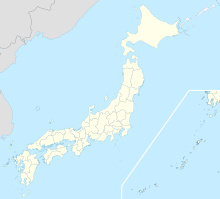
| RJBB Location in Osaka Prefecture Prove map of Osaka Prefecture RJBB Location in Kansai region Show map of Kansai region RJBB Location in Nippon Show map of Japan RJBB Location in Asia Show map of Asia | |||||||||||||||
| Runways | |||||||||||||||
| |||||||||||||||
| Statistics (2017) | |||||||||||||||
| |||||||||||||||



 11%)
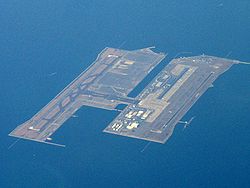
11%) Kansai International Drome (Japanese: 関西国際空港, romanized: Kansai Kokusai Kūkō ) commonly known as 関空 ( Kankū ) (IATA: KIX, ICAO: RJBB) is the principal international airport in the Greater Osaka Surface area of Nihon and the closest international aerodrome to the cities of Osaka, Kyoto, and Kobe. It is located on an artificial island (Kankūjima ( 関空島 )) in the middle of Osaka Bay off the Honshu shore, 38 km (24 mi) southwest of Ōsaka Station,[4] located within three municipalities, including Izumisano (n),[v] Sennan (southward),[6] and Tajiri (primal),[7] in Osaka Prefecture.
Kansai opened on 4 September 1994 to save overcrowding at the original Osaka International Aerodrome, referred to as Itami Airport , which is closer to the city of Osaka and now handles just domestic flights. It consists of two terminals: Terminal ane and Concluding 2. Last i, designed by Italian architect Renzo Piano, is the longest airport last in the world with a length of 1.7 km (1+ 1⁄xvi mi). The drome serves every bit an international hub for All Nippon Airways, Japan Airlines, and Nippon Cargo Airlines, and also serves as a hub for Peach, the first international low-cost carrier in Japan.
In 2016, 25.two million passengers used the airport, making information technology the 30th busiest airport in Asia and tertiary busiest in Japan. The freight book was 802,162 tonnes total: 757,414 t international (18th in the world) and 44,748 t domestic.[8] The 4,000 m × 60 thou (13,120 ft × 200 ft) second runway was opened on ii Baronial 2007. As of June 2014[update], Kansai Airport has become an Asian hub, with 780 weekly flights to Asia and Australasia (including freight 119), 59 weekly flights to Europe and the Middle East (freight 5), and lxxx weekly flights to North America (freight 42).[9]
In 2020, Kansai received Skytrax's awards for All-time Airdrome Staff in Asia, World's Best Airdrome Staff, and Earth'south All-time Airport for Baggage Delivery.[10] [11]
History [edit]

tertiary floor boarding antechamber, within the longest airport final in the earth
In the 1960s, when the Kansai region was rapidly losing trade to Tokyo, planners proposed a new airport near Kobe and Osaka. The city'south original international airdrome, Itami Airdrome, located in the densely populated suburbs of Itami and Toyonaka, was surrounded by buildings; information technology could non be expanded, and many of its neighbours had filed complaints considering of noise pollution problems.[12]
Afterward the protests surrounding New Tokyo International Aerodrome (now Narita International Airport), which was built with expropriated state in a rural part of Chiba Prefecture, planners decided to build the drome offshore. The new airport was office of a number of new developments to revitalize Osaka, which had been losing economic and cultural ground to Tokyo for most of the century.[13]
Initially, the drome was planned to exist congenital near Kobe, but the city of Kobe refused the plan, so the airdrome was moved to a more southerly location on Osaka Bay. At that place it could be open 24 hours per day, unlike its predecessor in the city.
Construction [edit]
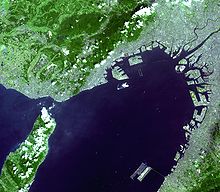
Satellite photo of Kansai Airport (lower-correct island) in Osaka Bay. Kobe Airport is existence built on the unfinished island nearly the middle of the photo. Primal Osaka is in the upper-right corner, forth with Osaka International.

An bogus island, 4 km (two+ 1⁄two mi) long and two.5 km (i+ 1⁄2 mi) wide, was proposed. Engineers needed to overcome the extremely high risks of earthquakes and typhoons (with storm surges of up to 3 m or 10 ft). The h2o depth is eighteen 1000 on elevation of 20 m of soft Holocene clay which holds 70% water.[14] [fifteen] [xvi] [17] A one thousand thousand sand drains were built into the clay to remove water and solidify the clay.[16] [17]
Construction started in 1987. The sea wall was finished in 1989 (fabricated of rock and 48,000 tetrapods). Three mountains were excavated for 21 million cubic metres (27 one thousand thousand cubic yards),[ citation needed ] and 180 million cubic metres (240 1000000 cubic yards) was used to construct isle 1.[fifteen] Over 3 years, 10,000 workers using 80 ships took 10 million work hours to consummate the thirty-or-40-metre (100 or 130 ft)[15] layer of earth over the body of water flooring and inside the sea wall. In 1990, a three-kilometer bridge was completed to connect the isle to the mainland at Rinku Town, at a toll of $1 billion.[ citation needed ] Completion of the artificial island increased the surface area of Osaka Prefecture just enough so that it is no longer the smallest prefecture in Japan (Kagawa Prefecture is now the smallest).[ citation needed ]
The bidding and structure of the airport was a source of international trade friction during the belatedly 1980s and early on 1990s. Prime number Government minister Yasuhiro Nakasone responded to American concerns, particularly from Senator Frank Murkowski, that bids would be rigged in Japanese companies' favour by providing special offices for prospective international contractors,[18] which ultimately did little to ease the participation of foreign contractors in the behest procedure.[19] Later on, strange airlines complained that ii-thirds of the departure hall counter space had been allocated to Japanese carriers, disproportionately to the bodily railroad vehicle of passengers through the airport.[20]
The isle had been predicted to sink v.7 k (18 ft viii in) past the most optimistic estimate as the weight of the cloth used for construction compressed the seabed silts. Still, by 1999, the isle had sunk 8.2 m (26 ft 11 in) – much more than than predicted. The project became the nearly expensive ceremonious works project in modern history afterwards twenty years of planning, three years of construction and U.s.$15bn of investment. Much of what was learned went into the successful artificial islands in silt deposits for New Kitakyushu Airport, Kobe Aerodrome, and Chūbu Centrair International Airdrome. The lessons of Kansai Airdrome were also applied in the construction of Hong Kong International Airport.[21]
In 1991, the last structure commenced. To compensate for the sinking of the island, adjustable columns were designed to support the last building. These are extended past inserting thick metal plates at their bases. Government officials proposed reducing the length of the terminal to cut costs, simply architect Renzo Piano insisted on keeping the final at its full planned length.[22] The drome was opened on 4 September 1994.[23]
On 17 Jan 1995, Japan was struck by the Peachy Hanshin earthquake, the epicenter of which was about twenty km (12 mi) away from KIX and killed 6,434 people on Japan'south main island of Honshū. Due to its earthquake engineering, the airport emerged unscathed, by and large due to the utilize of sliding joints. Even the glass in the windows remained intact. On 22 September 1998, the airport survived a draft with wind speeds over threescore m/southward (130 mph).[24]
On 19 Apr 2001, the airport was one of ten structures given the "Ceremonious Engineering Monument of the Millennium" laurels by the American Guild of Civil Engineers.[25]
As of 2008[update], the total cost of Kansai Aerodrome was $xx billion including country reclamation, two runways, terminals, and facilities. Most additional costs were initially due to the island sinking, expected due to the soft soils of Osaka Bay. After construction the charge per unit of sinking was considered then severe that the drome was widely criticized as a geotechnical engineering disaster. The sink rate fell from 50 cm (20 in) per yr during 1994 to 7 cm (iii in) per year in 2008.[26]
Operation [edit]
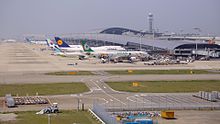
Kansai International Airport with the final building in the background

4th flooring ticketing hall, illustrating the terminal's airfoil roof
Opened on 4 September 1994, the airport serves as a hub for several airlines such as All Nippon Airways, Japan Airlines, and Nippon Cargo Airlines. It is the international gateway for Japan's Kansai region, which contains the major cities of Kyoto, Kobe, and Osaka. Other Kansai domestic flights fly from the older but more than conveniently located Osaka International Airdrome in Itami, or from the newer Kobe Airport.
The aerodrome had been deeply in debt, losing $560 one thousand thousand in interest every year. Airlines had been kept away by high landing fees (almost $7,500 for a Boeing 747), the second virtually expensive in the earth later Narita's. In the early years of the airport's operation, excessive terminal rent and utility bills for on-site concessions also collection up operating costs: some estimates before opening held that a cup of java would accept to cost US$10.[27] Osaka business concern owners pressed the regime to take a greater burden of the construction price to keep the airport attractive to passengers and airlines.[28]
On 17 February 2005, Chubu Centrair International Airport opened in Nagoya, just east of Osaka. The opening of the aerodrome was expected to increment competition betwixt Nihon's international airports. Despite this, passenger totals were up xi% in 2005 over 2004, and international passengers increased to three.06 million in 2006, up x% over 2005. Adding to the competition were the opening of Kobe Airport, less than 25 km (sixteen mi) away, in 2006 and the lengthening of the track at Tokushima Airport in Shikoku in 2007. The main rationale behind the expansions was to compete with Incheon International Airport and Hong Kong International Airdrome every bit a gateway to Asia, as Tokyo area airports were severely congested. Kansai saw a 5% year-on-year increment in international traffic in summer 2013, largely supported by low-cost carrier traffic to Taiwan and Southeast Asia overcoming a decrease in traffic to China and Republic of korea.[29]
The airport authority was allotted 4 billion yen in authorities support for fiscal twelvemonth 2013, and the Ministry of Land, Infrastructure, and Ship and the Ministry of Finance agreed to reduce this amount in stages through fiscal year 2015, although local governments in the Kansai region take pressed for continued subsidies.[30]
Kansai has been marketed as an culling to Narita Drome for international travelers from the Greater Tokyo Expanse. By flying to Kansai from Haneda Airdrome and connecting to international flights in that location, travelers can salvage the additional time required to get to Narita: upwardly to 1 and a half hours for many residents of Kanagawa Prefecture and southern Tokyo.
Expansion [edit]

Second phase of Kansai International Airport under construction
The drome was at its limit during peak times, owing especially to freight flights, so a portion of Phase 2 expansion—the second runway—was made a priority.[31] Thus, in 2003, believing that the sinking problem was almost over, the airport operators started to construct a iv,000 g (13,000 ft) 2nd runway and terminal.
The second runway opened on 2 Baronial 2007, but with the originally planned last portion postponed. This lowered the project cost to JPY¥910 billion (approx. US$viii billion), saving ¥650 billion from the first judge.[32] The additional rail development, which was opened in time for the IAAF globe athletics championships in Osaka, has expanded the airdrome size to 10.five square kilometres (2,600 acres). The second runway is used for landings and when there are incidents prohibiting takeoff from rail A. The new runway allowed the drome to start 24-hour operations in September 2007.[33] [34]
A new terminal building opened in late 2012.[35] There are additional plans for several new aprons, a third runway (06C/24C) with a length of 3,500 grand (11,483 ft), a new cargo last and expanding the airport size to 13 km2 (v sq mi). However, the Japanese authorities has currently postponed these plans for economic reasons.
Relationship with Itami Aerodrome [edit]
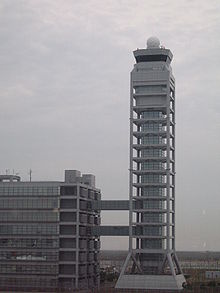
Since July 2008, Osaka Prefecture governor Toru Hashimoto has been a vocal critic of Itami Airport, arguing that the Chuo Shinkansen maglev line will make much of its domestic function irrelevant, and that its domestic functions should be transferred to Kansai Drome in conjunction with upgraded loftier-speed access to Kansai from central Osaka.[36] In 2009, Hashimoto also publicly proposed moving the functions of Marine Corps Air Station Futenma to Kansai Airdrome as a possible solution for the political crisis surrounding the base.[37]
In May 2011, the Diet of Japan passed legislation to grade a new Kansai International Airport Corporation using the country's existing equity pale in Kansai Airdrome and its property holdings at Itami Airport. The move was aimed at offsetting Kansai Airport's debt burden.[38]
The merger of the Itami and Kansai airport government was completed in July 2012. Presently following the merger, Kansai Airport announced a five% reduction in landing fees effective October 2012, with additional reductions during overnight hours when the airdrome is underutilized, and further discounts planned for the future, including subsidies for new airlines and routes. As of October 2012[update] these moves were intended to bring Kansai'southward fees closer to the level of Narita International Airport, where landing fees were around 20% lower than Kansai's, and to improve competitiveness with other Asian hubs such as Incheon International Airport in South Korea.[39]
Since its formation, the new operating company has also made efforts toward international expansion, bidding for operating concessions at Yangon International Airport and Hanthawaddy International Aerodrome in Myanmar.[40]
KIAC conducted a public tender to sell the operating rights for Kansai and Itami Airport in May 2015. Orix and Vinci SA were the sole bidders for the 45-yr contract, at a toll of around $xviii billion.[41] The new operating visitor, Kansai Airports, took over on ane April 2016.[42] It is 80% owned by Orix and Vinci, with the remaining 20% endemic by Kansai-based enterprises such as Hankyu Hanshin Holdings and Panasonic.[43]
Typhoon Jebi [edit]
On 4 September 2018, the aerodrome was hit by Typhoon Jebi. The airport had to pause operations afterwards seawater surges inundated the isle; runways were hit, and the water reached up to the engines of some shipping.[44] The situation was farther exacerbated when a large tanker crashed into the bridge that links the airport to the mainland, effectively stranding the people remaining at the airport.[45] All flights at the aerodrome were cancelled until half-dozen September, at which date Prime number Government minister Shinzō Abe appear the airport would partially resume domestic operations.[46] [47]
Train services to the airport resumed from xviii September 2022 later on repair works to the Kansai Airport Line and Nankai Airdrome Line were completed, and the airport resumed regular operations on 1 October 2018. Repairs to the damaged section of the Heaven Gate Span R were finally completed on viii April 2019, restoring traffic both to and from the mainland completely.
Terminals [edit]

Kansai International Airport'southward roof
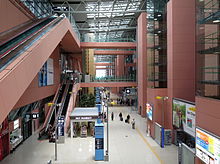
Terminal 1 Interior Escalator
Terminal one [edit]
The principal KIX passenger last, Terminal 1, is a unmarried iv-storey building designed by Renzo Piano Building Workshop (Renzo Piano and Noriaki Okabe), and has a gross floor infinite of 296,043 foursquare metres (3,186,580 sq ft). Every bit of 2018[update], at a total length of 1.vii km (i.ane mi) from end to cease, Final 1 is the longest airport terminal in the earth.[48] It has a sophisticated people mover system called the Wing Shuttle, which moves passengers from ane cease of the pier to the other.
The terminal's roof is shaped like an airfoil. This shape is used to promote air circulation through the building: giant air workout ducts blow air upwards at one side of the terminal, circulate the air across the curvature of the ceiling, and collect the air through intakes at the other side. Mobiles are suspended in the ticketing hall to take advantage of the flowing air.
The ticketing hall overlooks the international departures concourse, and the two are separated by a glass sectionalization. During Kansai's early on days, visitors were known to throw objects over the partition to friends in the corridor beneath. The segmentation was eventually modified to halt this practice.
On June 23, 2017, at the terminal's promotion space, a game experience area known as "Nintendo Check In" opened. In this game experience area, guests arriving at Last one can play Nintendo Switch games free of accuse. In that location is a statue of Mario at the feel expanse, along with Super Mario Cappy caps from Super Mario Odyssey for passengers to accept photos with. There likewise Amiibo figurines on display at that place. In the northern and southern inflow routes of Terminal 1, there are decorations of Nintendo characters like Mario, Luigi, Princess Peach, and others welcoming arriving passengers.[49]
Terminal two [edit]

Terminal 2 departures anteroom

Last two Restricted area shops
Concluding 2 is a low-cost carrier (LCC) terminal designed to attract more LCCs by providing lower landing fees than Terminal 1. It is exclusively occupied by Peach, Jump Airlines, and Jeju Air. Other LCCs serving Kansai, such every bit Jetstar Airways, Jetstar Nippon, and Cebu Pacific Air, use the master Last 1.[50]
Peach requested that Terminal 2 take a simplified design in gild to minimize operating costs.[51] The last is a unmarried-story building, thus eliminating the cost of elevators. Passageways to shipping have no air conditioning.[52] The terminal as well has no jet bridges, having one boarding gate for domestic departures and ane boarding gate for international departures. In case of rain, passengers are lent umbrellas to apply as they walk to the aircraft.[53]
Terminal ii is not direct continued to Last i or to Kansai Drome Station. Free shuttle buses run between the two terminals, and betwixt Terminal ii and the railway and ferry stations. It is also possible to walk between the terminals through the KIX Sora Park, a four-hectare park located adjacent to Terminal 2.[54]
Statistics [edit]
Airlines and destinations [edit]
Passenger [edit]
| Airlines | Destinations |
|---|---|
| 9 Air | Guangzhou[55] |
| Aeroflot | Moscow–Sheremetyevo[56] |
| AirAsia X | Honolulu,[57] Kuala Lumpur–International, Taipei–Taoyuan[58] |
| Air Busan | Busan, Seoul–Incheon[59] |
| Air Canada | Seasonal: Vancouver |
| Air China | Beijing–Capital, Chengdu–Shuangliu, Dalian, Hangzhou,[sixty] Shanghai–Pudong, Tianjin[61] |
| Air France | Paris–Charles de Gaulle |
| Air Macau | Macau |
| Air New Zealand | Seasonal: Auckland |
| Air Seoul | Seoul–Incheon[62] |
| All Nihon Airways | Beijing–Uppercase, Chicago-O'hare, Dalian, Fukuoka, Hangzhou, Hong Kong, Houston-Intercontinental, Ishigaki, Los Angeles, Miyako, Naha, Qingdao, Sapporo–Chitose, Shanghai–Pudong, Tokyo–Haneda Seasonal: Asahikawa |
| Asiana Airlines | Seoul–Gimpo, Seoul–Incheon Seasonal: Saipan |
| Beijing Capital letter Airlines | Hangzhou |
| Cathay Pacific | Hong Kong, Taipei–Taoyuan |
| Cebu Pacific | Manila |
| Cathay Airlines | Kaohsiung, Tainan, Taipei–Taoyuan |
| China Eastern Airlines | Beijing–Daxing, Dalian,[63] Hangzhou, Kunming, Nanchang,[64] Nanjing, Ningbo, Qingdao, Shanghai–Pudong, Eleven'an, Yanji,[65] Yantai |
| China Southern Airlines | Changchun,[66] Changsha, Dalian, Guangzhou, Guiyang, Harbin, Shanghai–Pudong, Shenyang, Shenzhen, Wuhan, Zhengzhou |
| China United Airlines | Lianyungang[67] |
| Eastar Jet | Busan,[68] Seoul–Incheon |
| EgyptAir | Seasonal charter: Cairo[69] |
| Emirates | Dubai–International |
| EVA Air | Kaohsiung, Taipei–Taoyuan |
| Finnair | Helsinki |
| Hainan Airlines | Beijing–Capital,[seventy] Haikou,[71] Lianyungang,[72] Shenzhen,[73] Xi'an[74] |
| Hawaiian Airlines | Honolulu |
| Hebei Airlines | Shijiazhuang[75] |
| HK Express | Hong Kong |
| Hong Kong Airlines | Hong Kong |
| Japan Airlines | Bangkok–Suvarnabhumi, Honolulu, Ishigaki, Los Angeles, Sapporo–Chitose, Shanghai–Pudong, Taipei–Taoyuan, Tokyo–Haneda |
| Japan Transocean Air | Naha |
| Jeju Air | Busan, Cheongju,[76] Guam,[76] Seoul–Gimpo, Seoul–Incheon Seasonal: Muan[77] |
| Jetstar | Cairns |
| Jetstar Asia Airways | Clark,[78] Manila, Singapore, Taipei–Taoyuan |
| Jetstar Nippon | Fukuoka, Hong Kong, Kochi,[79] Kumamoto,[80] Manila, Naha, Sapporo–Chitose, Shimojishima,[81] Taipei–Taoyuan, Tokyo–Narita |
| Jin Air | Busan,[82] Seoul–Incheon |
| Juneyao Airlines | Changsha,[83] Changzhou,[84] Harbin,[84] Nanjing,[85] Qingdao,[86] Shanghai–Pudong, Wenzhou,[84] Wuhan[84] |
| KLM | Amsterdam |
| Korean Air | Seoul–Gimpo, Seoul–Incheon |
| Loong Air | Hangzhou[87] |
| Lufthansa | Munich[88] |
| Malaysia Airlines | Kuala Lumpur–International |
| Okay Airways | Changsha,[89] Hangzhou,[90] Linyi,[91] Tianjin |
| Peach Aviation | Amami Oshima, Fukuoka, Hong Kong, Ishigaki, Kagoshima, Kaohsiung, Kushiro,[92] Memanbetsu, Miyazaki, Nagasaki, Naha, Niigata,[93] Sapporo–Chitose, Sendai, Seoul–Incheon, Shanghai–Pudong, Taipei–Taoyuan, Tokyo–Narita |
| Philippine Airlines | Cebu, Manila |
| Philippines AirAsia | Manila[94] |
| Qantas | Sydney[95] [96] |
| Scoot | Bangkok–Don Mueang, Kaohsiung, Singapore |
| Shandong Airlines | Jinan, Qingdao,[97] Urumqi |
| Shanghai Airlines | Shanghai–Pudong |
| Shenzhen Airlines | Beijing–Uppercase,[98] Nanchang,[99] Nantong,[100] Shenzhen, Wuxi |
| Sichuan Airlines | Chengdu–Shuangliu, Xi'an,[101] Zhangjiajie[102] |
| Singapore Airlines | Singapore |
| Bound Airlines | Chongqing, Dalian,[103] Guangzhou,[104] Luoyang, Qingdao, Shanghai–Pudong, Shenyang,[105] Tianjin, Wuhan, Xiamen,[106] Xi'an,[107] Yangzhou |
| StarFlyer | Tokyo–Haneda |
| Starlux Airlines | Taipei–Taoyuan[108] |
| Thai AirAsia 10 | Bangkok–Don Mueang |
| Thai Airways | Bangkok–Suvarnabhumi |
| Thai Panthera leo Air | Bangkok–Don Mueang[109] |
| Tianjin Airlines | Tianjin |
| Tigerair Taiwan | Kaohsiung,[110] Taipei–Taoyuan |
| Turkish Airlines | Istanbul[111] |
| T'way Airlines | Busan,[112] Daegu, Guam,[113] Jeju,[112] Muan, Seoul–Incheon |
| United Airlines | Guam, San Francisco |
| VietJet Air | Hanoi,[114] Ho Chi Minh Metropolis[115] |
| Vietnam Airlines | Da Nang,[116] Hanoi, Ho Chi Minh Metropolis |
| West Air | Chongqing, Zhengzhou[117] |
| XiamenAir | Fuzhou, Hangzhou,[118] Qingdao,[119] Xiamen |
Cargo [edit]
| Airlines | Destinations |
|---|---|
| Air China Cargo | Beijing–Capital letter, Shanghai–Pudong |
| ANA Cargo | Bangkok–Suvarnabhumi, Dalian, Naha, Qingdao, Shanghai–Pudong, Tianjin, Tokyo–Narita |
| Asiana Cargo | Seoul–Incheon |
| Cargolux Italia | Milan-Malpensa, Hong Kong |
| Prc Pacific Cargo | Hong Kong, Seoul–Incheon |
| China Airlines Cargo | Anchorage, Los Angeles, Taipei–Taoyuan |
| China Cargo Airlines | Shanghai–Pudong |
| China Postal Airlines | Shanghai–Pudong |
| DHL Aviation operated by Air Hong Kong | Hong Kong |
| EVA Air Cargo | Taipei–Taoyuan, Anchorage |
| FedEx Express | Anchorage, Beijing–Capital, Guangzhou, Hong Kong, Memphis, Oakland, Paris–Charles de Gaulle, Singapore, Shanghai–Pudong, Taipei–Taoyuan, Tokyo–Narita |
| Garuda Cargo | Jakarta–Soekarno–Hatta |
| Korean Air Cargo | Seoul–Incheon |
| Lufthansa Cargo | Frankfurt, Krasnoyarsk, Seoul-Incheon[120] |
| Qatar Airways Cargo | Doha, Hong Kong |
| SF Airlines | Changsha,[121] Wuhan[122] |
| Sichuan Airlines Cargo | Nantong |
| Silk Fashion West Airlines | Baku, Seoul–Incheon |
| Suparna Airlines | Shanghai–Pudong |
| UPS Airlines | Anchorage, Shanghai–Pudong, Shenzhen, Tokyo–Narita |
Basis transportation [edit]
Rail [edit]
Kansai International Airport is continued merely by the Sky Gate Span R and by a road and railroad span to Rinku Town and the mainland. The lower railroad level of the bridge is used by two railroad operators: JR West and Nankai Electric Railway.
JR West operates the Haruka limited express train services for Kansai Airport Station from Tennōji, Shin-Ōsaka, and Kyoto Station. JR Westward too offers "Kansai Airport Rapid" services for Kansai Airport Station from Ōsaka, Kyōbashi Station, and several stations on the manner. Diverse connections, such every bit buses, subways, trams, and other railroads, are available at each station.
Nankai operates the rapi:t, a limited express railroad train service to Namba Station on the southern border of downtown Osaka. Osaka Metro connections are bachelor at Namba and Tengachaya Station.
Motorbus [edit]
Kansai Aerodrome Transportation Enterprise[123] and other charabanc operators offer scheduled limited bus services, called "Airport Limousines", for Kansai International Drome.
Parking [edit]
Two six story parking structures, called P1 and P2, are located above a railroad terminal station, while the other two level parking facilities, called P3 and P4, are situated next to "Aeroplaza", a hotel circuitous.
The airport is but accessible from the Sky Gate Span R, a function of Kansai Aerodrome Expressway. The expressway immediately connects to Hanshin Expressways Road five, "Wangan Route", and Hanwa Expressway.
Because of the damage sustained during Typhoon Jebi in September 2018, in which two route spans on the southern (airport-bound) side were dislodged and partially crushed by a tanker that had come unmoored in the storm, both lanes of traffic accept been rerouted onto the northern (shore-jump) side, and customers are urged to use public transit whenever possible, especially during peak hours.
Ferry service [edit]
In July 2007, high-speed ferry service began. OM Kobe operates "Bay Shuttle" between Kobe Airport and KIX. The journey takes about thirty minutes.
Other facilities [edit]

Kensetsu-to, the headquarters of Peach Aviation and the Kansai International Airport Country Development Co., Ltd.

Sky Gate Bridge to the mainland
- Kansai Airport Agency Company Edifice ( 航空会社北ビル , Kūkō Kaisha Kita Biru ) – Houses the Kansai Airport Bureau Co., Ltd. ( 株式会社 関西エアポートエージェンシー , Kabushiki Kaisha Kansai Eapōto Ējenshī ) [124] [125]
- Kensetsu-to ( 建設棟 , Kensetsu-tō )
- The head office of the Kansai International Airport Country Development Co., Ltd. / KALD ( 関西国際空港用地造成株式会社 , Kansai Kokusai Kūkō Yōchi Zōsei Kabushiki Kaisha ) is on the 4th flooring.[126]
- The Peach Aviation head role is on the fifth floor.[127] [128]
- Aeroplaza ( エアロプラザ , Earopuraza ) is located on the west side of Kansai Drome Station. It includes a hotel, restaurants, rental machine counters, and other businesses[129]
- Hotel Nikko Kansai Aerodrome (north portion of Kansai Airport)[5]
- Head office of Peach Aviation was previously located on the 3rd floor (fundamental portion of Kansai Aerodrome)[130] [131]
- Central ability station (KEPCO) free energy middle, xl MW
- JAL Cargo import and export facilities (in southern portion)[half-dozen]
- Japan Coast Guard Kansai airport Declension Guard air base
- Japan Coast Guard Special Security Team Base
- Osaka international mail service office (Equally of 2010[update] carrying about xix,000 tonnes per year of international postal affair)
- Oil tanker berths (three berths) and Fuel Supply center
- Airport access span ("The Heaven Gate Bridge R"), which as of 2013 is the longest truss span in the world at iii,750 m (12,303 ft).[132] The double-decker bridge consists of a lower deck devoted to rail, with the upper for road.
Run into also [edit]
- Kansai Airports
- Itami Drome
- Kobe Airdrome
References [edit]
- ^ "New Management Setup of Kansai Airport" (PDF). Kansai Airports. Kansai Airports. i Apr 2016. Retrieved 24 April 2016.
- ^ "FedEx Opens Northward Pacific Regional Hub at Kansai International Airport". newswit.com. three July 2014. Retrieved three July 2014.
- ^ Heng, Melissa (31 January 2020). "SIA-ANA pact will pave fashion for more than flights, Nippon destinations for Singapore consumers". The Straits Times. Singapore. Retrieved 31 Jan 2020.
- ^ "AIS Japan". 22 July 2011. Archived from the original on 22 July 2011. Retrieved 15 July 2018.
- ^ a b Home Archived 8 August 2011 at the Wayback Machine. Hotel Nikko Kansai Airport. Retrieved on 23 July 2011. "Hotel Nikko Kansai Airport 1, Senshu-kuko Kita, Izumisano-shi, Osaka, 549-0001, Nihon "
- ^ a b "OSAKA KANSAI (Kansai International Aerodrome)." JAL Cargo. Retrieved on 23 July 2011. "Deviation JAL Consign Cargo Bldg. 1 Senshu Drome Minami, Sennan, Osaka Arrival JALKAS Import Cargo Bldg. i Senshu Aerodrome Minami, Sennan, Osaka"
- ^ 航空運送事業の許可について(Peach・Aviation 株式会社). Ministry building of Land, Infrastructure, Transport, and Tourism. 7 July 2011. Retrieved 21 July 2011.
1.本社所在地 大阪府泉南郡田尻町泉州空港中1番地(関西空港内)
- ^ Kansai International Drome Statistics Archived 29 May 2012 at the Wayback Machine – Kansai International Airport Co., Ltd.
- ^ Kansai International Airdrome 2022 summer Flight Schedules – Kansai International Airport Co., Ltd.
- ^ "The World's Best Airports in 2022 are appear". SKYTRAX. 11 May 2020. Retrieved 15 May 2020.
- ^ Cripps, Karla. "The globe'due south best airports for 2020, according to Skytrax". CNN . Retrieved 15 May 2020.
- ^ Shigeto Tsuru (1999). The Political Economy of the Surroundings: The Case of Nihon. UBC Press. p. 107. ISBN978-0-7748-0763-0 . Retrieved xix April 2020.
- ^ Osaka Journal; Impatient City'due south Mission: Steal Tokyo's Thunder, New York Times, 9 December 1989.
- ^ Rice, Peter (4 September 1994). "Kansai International Airport terminal edifice". Engineering Timelines / Arup Grouping. Retrieved 24 March 2017.
- ^ a b c Mesri, Gholamreza (February 2015). "Settlement of the Kansai International Airport Islands". Periodical of Geotechnical and Geoenvironmental Engineering. ASCE Library. 141 (two): 04014102. doi:10.1061/(asce)gt.1943-5606.0001224.
- ^ a b "Kansai International Airport Country Co., Ltd - Technical Information - Land Settlement - Why Sett". Retrieved 24 March 2017.
- ^ a b "Kansai International Airport Country Co., Ltd - Technical Data - Approach to Settlement - Condition of the Settlement". Kansai. Retrieved 24 March 2017.
- ^ Some Modest Gains on Trade Conflicts, New York Times, 2 May 1987.
- ^ U.s.a. Cancels A Plan To Brainstorm Sanctions After Japan Acts, New York Times, 27 October 1993.
- ^ Osaka Notebook, International Herald Tribune, 24 Baronial 1992.
- ^ Sinking Feeling at Hong Kong Airport, International Herald Tribune, 22 January 1982.
- ^ Osaka Periodical; Huge Airport Has Its Wings Clipped, New York Times, iii July 1991.
- ^ 関西空港の施設・設備 (in Japanese). Retrieved 29 October 2019.
- ^ Steven R. Talley (14 March 2000). Super Structures of the World: Kansai International Airport (documentary). Learning Aqueduct Productions.
- ^ U.S. Applied science Society names Kansai International Airport a Civil Engineering Monument of the Millennium Archived 13 October 2009 at the Wayback Machine – Press release from American Society of Civil Engineers
- ^ "Kansai International Airdrome Land Co., Ltd - Technical Data - Approach to Settlement - Condition of the Settlement". Retrieved 4 June 2015.
- ^ Will Fees Sink New Osaka Airport?, International Herald Tribune, 5 August 1994.
- ^ Pride and (Ouch!) Price: The $14 Billion Airdrome, New York Times, 16 December 1993.
- ^ 関空、夏季の国際線旅客5%増 台湾・東南ア顧客が増加見通し. Nikkei. xix July 2013. Retrieved 19 July 2013.
- ^ 関空支援を国に要望 促進協、ターミナル整備など. Nikkei. 22 August 2013. Retrieved 22 August 2013.
- ^ The reason for construction of the 2nd runway Archived 22 July 2007 at the Wayback Automobile– Kansai International Airdrome Co., Ltd.
- ^ "– Daily Yomiuri Online – Opening of new KIX track celebrated".
- ^ "Kansai opens its Second Rails", Airports – September/Oct 2007 (Primal Publishing), P7
- ^ "24 hours operation from 1 September 2007" from Sankei Newspaper (Japanese) on 24 August 2007.
- ^ KIX Terminal2 Archived 16 January 2013 at the Wayback Machine. Kansai-airport.or.jp (28 Oct 2012). Retrieved on xvi August 2013.
- ^ Airport wars roil Kansai region, Japan Times
- ^ Volition the U.S. Marines charge aground at Kansai airport?, Japan Today
- ^ 関空・伊丹統合法が成立 1兆円超す負債解消目指す. Asahi Shimbun (in Japanese). 17 May 2011.
- ^ 関空、国際線着陸料5%下げ LCC誘致へ10月から. Nikkei (in Japanese).
- ^ 新関空会社、ミャンマーの国際空港入札に参加 海外2カ所目. Nikkei (in Japanese). 30 June 2013.
- ^ Fujita, Junko (22 May 2015). "Orix but confirmed bidder for Kansai airport rights later on more drib out". Reuters . Retrieved 14 September 2015.
- ^ "New Management Fix-up of Kansai Airports" (PDF) . Retrieved fifteen July 2018.
- ^ 伊藤, 正泰 (xi September 2015). 新関空会社とオリックス陣営、空港運営権の売却で大筋合意. Nikkei (in Japanese). Retrieved 14 September 2015.
- ^ "Typhoon impairment shuts cardinal Nihon airdrome". 5 September 2018. Retrieved 2 January 2020.
- ^ The Mainichi (four September 2018). "Ship smashes into Kansai airport bridge as typhoon hits Japan". Archived from the original on 4 September 2018. Retrieved 4 September 2018.
- ^ NHK World News (six September 2018). "Abe: Kansai airport to partially reopen on Friday". Archived from the original on 6 September 2018. Retrieved 6 September 2018.
- ^ https://nytimes.com 7 September 2018: Many Major Airports Are Near Ocean Level. A Disaster in Japan Shows What Tin can Go Wrong. (incl. photo of the partially flooded airdrome)
- ^ "Osaka Kansai International Drome". Skyscanner. 31 May 2018. Archived from the original on 11 October 2018. Retrieved xi October 2018.
- ^ ""Nintendo Check In" will open up! Get hands-on experience of Nintendo games at KIX" (PDF).
- ^ Commercial offer to the fore every bit Kansai opens budget concluding. TheMoodieReport.com. Retrieved on 16 August 2013.
- ^ Kansai Airport opens new terminal for low-cost carriers – AJW past The Asahi Shimbun Archived 1 November 2012 at the Wayback Motorcar. Ajw.asahi.com. Retrieved on 16 August 2013.
- ^ 関空、格安航空専用の第2ターミナル28日開業. Nikkei (in Japanese). 27 October 2012. Retrieved vii January 2020.
- ^ 関空に格安航空専用ターミナル 第1便が出発. Nikkei (in Japanese). 28 Oct 2012. Retrieved seven Jan 2020.
- ^ Large "Ecopark" Outside Kansai Terminal ii with Fields, "Ecofarm" and More than – Airport News Japan Archived viii November 2022 at the Wayback Motorcar. En.airportnews.jp (25 October 2012). Retrieved on xvi August 2013.
- ^ "ix Air adds Guangzhou – Osaka service from tardily-Dec 2019".
- ^ "Aeroflot revises planned long-haul additions in 2020/21". Routesonline.
- ^ Liu, Jim. "AirAsia X proposes Honolulu launch in June 2017". Routesonline. Informa Markets. Retrieved 6 Feb 2017.
- ^ Liu, Jim (31 October 2018). "AirAsia X adds Taipei – Osaka service from late-Jan 2019". Routesonline. Informa Markets.
- ^ "Air Busan adds new routes in April 2020".
- ^ "Air People's republic of china to launch new KIX-Hangzhou service with four weekly flights this winter" (PDF). Kansai Airport. Retrieved 5 December 2018.
- ^ Liu, Jim. "Air Communist china adds Tianjin to Osaka service". Routesonline. Informa Markets. Retrieved 30 January 2019.
- ^ Liu, Jim. "Air Seoul files preliminary Osaka schedule from Sep 2017". Routesonline. Informa Markets. Retrieved 12 June 2017.
- ^ Liu, Jim. "Prc Eastern revises Dalian – Osaka service in W17". Routesonline. Informa Markets. Retrieved 30 October 2017.
- ^ Liu, Jim. "China Eastern W19 Japan service changes". Routesonline . Retrieved 30 September 2019.
- ^ "Prc Eastern Adds Yanji – Osaka Service from July 2015 :: Routesonline". Airlineroute.net. Retrieved 15 July 2018.
- ^ "China Southern resumes Changchun – Osaka service from June 2019". Routesonline.
- ^ Liu, Jim. "China United Airlines adds Lianyungang – Osaka service from belatedly-Feb 2020". Routesonline . Retrieved fourteen January 2020.
- ^ Liu, Jim (17 July 2019). "EastarJet suspends Busan – Nippon service in Sep/October 2019". Routesonline. Informa Markets.
- ^ Liu, Jim (14 October 2019). "EGYPTAIR resumes Osaka lease flights in W19". routesonline.com.
- ^ "Hainan Airlines adds new Beijing Uppercase – Nihon routes in W19".
- ^ "Hainan Airlines launches Haikou-Osaka flights". Nippon Today.
- ^ "Hainan Airlines plans Lianyungang – Osaka service from late-Nov 2019". routesonline. Retrieved xv October 2019.
- ^ Liu, Jim (1 January 2019). "Hainan Airlines adds Shenzhen – Osaka service from Feb 2019". Routesonline. Informa Markets.
- ^ Liu, Jim. "Hainan Airlines plans Xi'An – Osaka service from July 2019". Routesonline. Informa Markets. Retrieved 5 June 2019.
- ^ "Hebei Airlines adds Shijiazhuang – Osaka service from Jan 2020".
- ^ a b Liu, Jim. "Jeju Air adds Osaka – Guam service from belatedly-July 2018". Routesonline. Informa Markets. Retrieved 15 July 2018.
- ^ Liu, Jim. "Jeju Air schedules international service from Muan in 2Q18". Routesonline. Informa Markets. Retrieved 15 July 2018.
- ^ "Jetstar Asia launches first direct service to Osaka from Clark". Jetstar.com . Retrieved 26 January 2018.
- ^ "Jetstar Japan to launch Tokyo Narita/Osaka Kansai-Kochi services". CAPA. Retrieved 14 September 2018.
- ^ "Jetstar Japan to launch new daily service from KIX to Kumamoto" (PDF). Kansai Airport. Retrieved 19 July 2018.
- ^ Liu, Jim. "Jetstar Japan adds Osaka – Shimojishima service from July 2019". Routesonline. Informa Markets. Retrieved 17 March 2019.
- ^ "Jin Air Adds New Routes from Busan eff late-Sept 2015". Airlineroute.net. 24 August 2015. Retrieved 24 August 2015.
- ^ Liu, Jim. "Juneyao Airlines adds Changsha – Osaka from July 2019". Routesonline. Informa Markets. Retrieved half-dozen May 2019.
- ^ a b c d "Juneyao Airlines adds new routes to Nihon in W19". routesonline. Retrieved 9 September 2019.
- ^ Liu, Jim. "Juneyao Airlines Adds Nanjing – Osaka Route from Aug 2016". Routesonline. Informa Markets. Retrieved 17 June 2016.
- ^ Liu, Jim. "Juneyao Airlines adds Qingdao – Osaka service from late-March 2019". Routesonline. Informa Markets. Retrieved 26 February 2019.
- ^ Liu, Jim. "Loong Air expands Hangzhou International routes in Nov/Dec 2019". Routesonline . Retrieved eleven December 2019.
- ^ Liu, Jim. "Lufthansa S19 long-haul changes as of 10OCT18". Routesonline. Informa Markets. Retrieved xxx October 2018.
- ^ "Okay Airways adds Changsha – Osaka from late-July 2019".
- ^ "Okay Airways schedules new routes to Japan in November 2019".
- ^ Liu, Jim. "Okay Airways adds Linyi – Osaka service from December 2019". Routesonline . Retrieved 11 December 2019.
- ^ Liu, Jim. "Peach begin service to Kushiro from 2018". Routesonline. Informa Markets. Retrieved 15 July 2018.
- ^ Liu, Jim. "Peach adds Osaka – Niigata service in March 2018". Routesonline. Informa Markets. Retrieved xv July 2018.
- ^ "AirAsia to wing betwixt the Philippines and Japan". AirAsia Newsroom.
- ^ "Qantas to launch seasonal Sydney-Osaka flights". Australian Business concern Traveller. Retrieved 27 July 2017.
- ^ Liu, Jim. "Qantas converts Sydney – Osaka to yr-round service in 2018". Routesonline. Informa Markets. Retrieved 14 September 2017.
- ^ "Shandong Airlines Adds New Osaka Service from July 2015". Airlineroute.internet. 4 June 2015. Retrieved 4 June 2015.
- ^ "Shenzhen Airlines to Start Beijing - Osaka Flight from July 2015". Airlineroute.net. 29 April 2015. Retrieved 29 April 2015.
- ^ "Shenzhen Airlines adds new routes to Nihon in W19". routesonline. Retrieved sixteen September 2019.
- ^ "Shenzhen Airlines Expands Osaka Service in W15". Airlineroute.cyberspace. x Nov 2015. Retrieved 10 November 2015.
- ^ Liu, Jim. "Sichuan Airlines adds Eleven'An – Osaka from late-November 2018". Routesonline. Informa Markets. Retrieved 30 October 2018.
- ^ Liu, Jim. "Sichuan Airlines plans Dayong – Osaka launch in Baronial 2019". Routesonline. Informa Markets. Retrieved 17 July 2019.
- ^ "Spring Airlines adds Dalian – Osaka service from November 2018". Routesonline.
- ^ Liu, Jim. "Spring Airlines adds Guangzhou – Osaka service from Feb 2019". Routesonline. Informa Markets. Retrieved 10 Jan 2019.
- ^ Liu, Jim. "Leap Airlines adds Shenyang – Osaka service from Jan 2020". Routesonline . Retrieved 24 Dec 2019.
- ^ Liu, Jim. "Bound Airlines adds Xiamen – Osaka service from mid-Dec 2019". Routesonline . Retrieved eighteen Nov 2019.
- ^ "Spring Airlines Launches 4 New People's republic of china – Osaka Routes in S15". Retrieved 4 June 2015.
- ^ Liu, Jim. "Starlux Airlines schedules network expansion in December 2020". Routesonline . Retrieved 26 October 2020.
- ^ Liu, Jim. "Thai Panthera leo Air schedules additional routes to Nippon in 1Q19". Routesonline. Informa Markets. Retrieved 27 January 2018.
- ^ "tigerair Taiwan Adds Kaohsiung - Osaka; Bangkok Service Reductions from July 2015". Airlineroute.net. 16 June 2015. Retrieved 16 June 2015.
- ^ "Turkish Airlines delays Osaka service resumption to March 2021". Routesonline.
- ^ a b Liu, Jim. "T'Fashion Air boosts Osaka flights in S17". Routesonline. Informa Markets. Retrieved 8 May 2017.
- ^ "Tway". Twayair.com. Archived from the original on viii September 2015. Retrieved fifteen July 2018.
- ^ "vietjet-opens-direct-flight-from-hanoi-to-osaka--japan - news - VietJetAir.com - Enjoy Flying!". www.vietjetair.com.
- ^ Liu, Jim. "Vietjet Air adds Ho Chi Minh City – Osaka route from December 2018". Routesonline. Informa Markets. Retrieved 25 July 2018.
- ^ "Vietnam Airlines to offer new route betwixt KIX and Da Nang" (PDF). Kansai Airport. Retrieved 30 Baronial 2018.
- ^ Liu, Jim (2 October 2019). "Due west Air adds new Osaka routes from late-November 2019". routesonline.com.
- ^ Liu, Jim. "Xiamen Airlines plans Hangzhou – Osaka launch in late-Oct 2018". Routesonline. Informa Markets. Retrieved 25 September 2018.
- ^ "Xiamen Airlines W19 Japan service changes". Routesonline.
- ^ "Alive Flight Tracker - Real-Time Flight Tracker Map". Flightradar24.
- ^ https://world wide web.payloadasia.com/carriers/new-air-cargo-route-links-changsha-to-osaka/
- ^ https://www.aircargonews.net/airlines/sf-airlines-launches-frankfurt-freighter-link/[ bare URL ]
- ^ "Kansai Airdrome limousine". Retrieved four June 2015.
- ^ "090406a.pdf Archived 25 Apr 2012 at the Wayback Machine." Kansai International Aerodrome State Development Co., Ltd. Retrieved on two November 2011. "Kansai Airdrome Agency Company Building (4F) 1 Senshu-Kuko Kita, Izumisano, Osaka 549-0001"
- ^ 会社情報 (in Japanese). Kansai Airport Agency. Archived from the original on 17 November 2011. Retrieved 2 November 2011.
" 〒549-0001 大阪府泉佐野市泉州空港北1番地航空会社北ビル4F"
." - ^ 見学ホール (in Japanese). Kansai International Airport State Evolution Co., Ltd. Archived from the original on 25 April 2012. Retrieved ane November 2011.
〒549–0001 大阪府泉佐野市泉州空港北一番地 建設棟4F
." - ^ "Privacy Policy." Peach Aviation. Retrieved on 23 July 2011. "Peach Aviation Limited Kensetsu-to 5th floor, ane-Senshukuko-kita, Izumisano-shi, Osaka, Japan 549-8585" – Japanese: " 〒549-8585 大阪府泉佐野市泉州空港北一番地 建設棟5階 Peach Aviation株式会社 "
- ^ "Almost United states." Peach. Retrieved on 1 November 2011. "Izumisano-shi, Osaka, Nihon 549-8585" Address in Japanese: " 大阪府泉佐野市 "
- ^ "Aerodrome Facilities Data Archived 5 June 2011 at the Wayback Machine." Kansai International Airport. Retrieved on 23 July 2011. ""
- ^ "Privacy Policy." Peach Aviation. Retrieved on 23 July 2011. "Personal information desk Peach Aviation Limited Aeroplaza 3F, 1 Senshu-kuko-naka, Tajiricho, Sennan-gun, Osaka 549-8585, Japan" – Japanese: " 〒549-8585 大阪府泉南郡田尻町泉州空港中1 番地エアロプラザ3F Peach Aviation株式会社 個人情報取り扱い担当行き "
- ^ "About Us." Peach. Retrieved on 21 July 2011. "Tajiri-cho, Sennangun, Osaka, Japan" Accost in Japanese: " 本社所在地 大阪府泉南郡田尻町 "
- ^ Chen, Wai-Fah; Duan, Lian (11 October 2013). Handbook of International Bridge Applied science. CRC Press. ISBN978-1-4398-1030-nine.
Further reading [edit]
- Hausler, E. and N. Sitar. "Performance of Soil Improvement Techniques in Earthquakes." (Archive) (Report in Progress) Pacific Earthquake Engineering Inquiry Center, University of California Berkeley.
External links [edit]
- (in English) KIX operations website
- KIX corporate website
- KIX evolution website
- History of KIX
- About the projection of Kansai International Airport
Source: https://en.wikipedia.org/wiki/Kansai_International_Airport
0 Response to "When Will Kix Airport Be Open Again"
Enviar um comentário